Choosing a face match threshold when real matches score 0.72 and impostors 0.33
How Insula compares faces against a gallery with the top three scores, why a wide gap between genuine and impostor scores matters more than the model, and how unknown faces and household gestures use the result.
- Published
- 2 min
- To read
- Insula
- Project
A face recognition system turns two faces into a number and then has to decide what number counts as the same person. Where that line goes controls every mistake the system will make. Insula, the camera system also called camOS, was measured on real footage, and the measurements are worth looking at because they show how much room the choice has.
Two scores with room between them
Insula compares a face seen by the camera against a gallery of known faces. The comparison uses the top three scores against the gallery, so one odd frame counts for less.
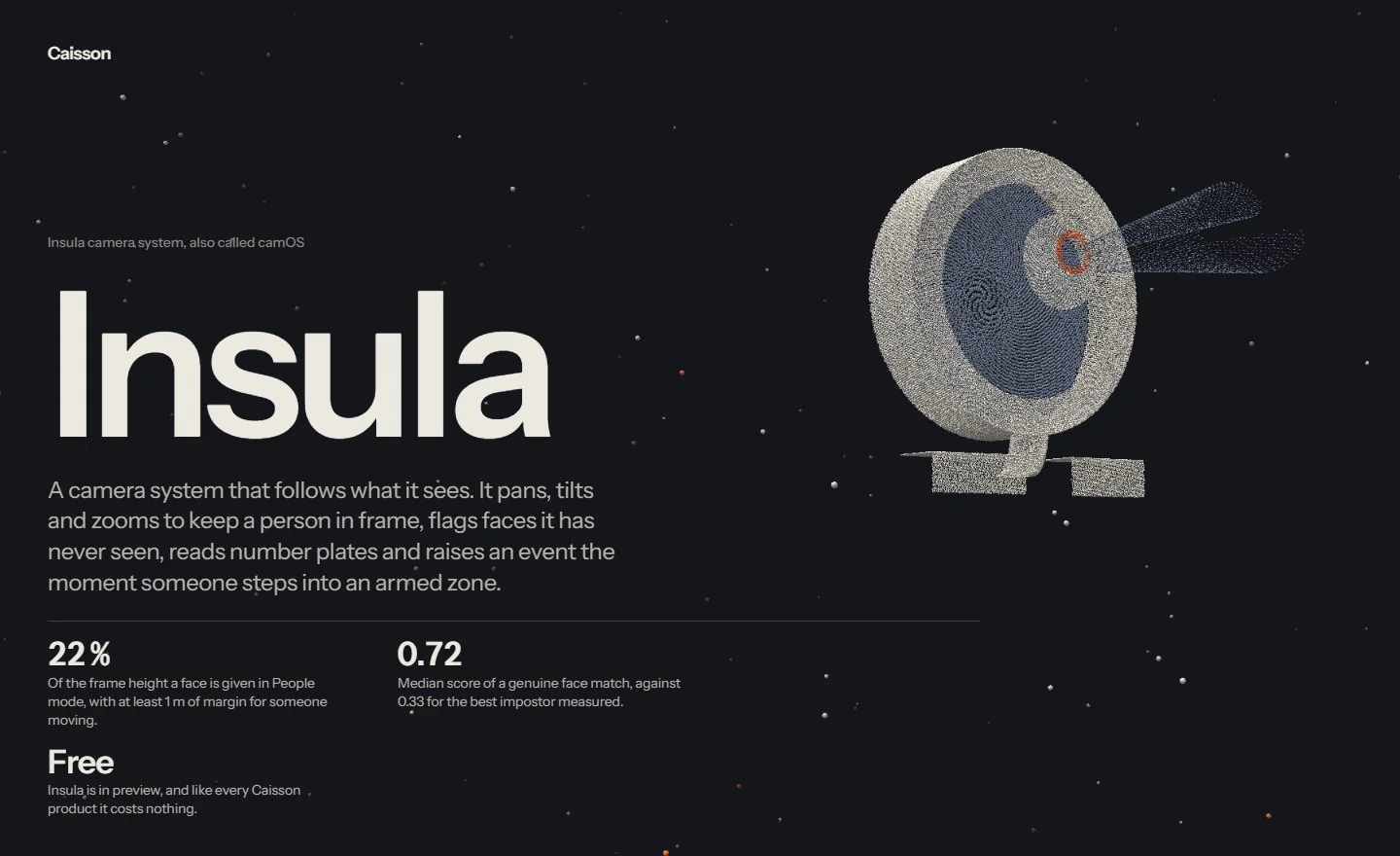
On real footage from the camera, genuine matches, where the face in front of the lens really was the known person, had a median score of 0.72. The best impostor, the highest score any other face reached against that person, was 0.33.
The gap between 0.33 and 0.72 is the useful fact. A threshold anywhere in it separates the two groups on that footage. A system whose genuine and impostor scores overlap has to trade one kind of error for the other. A system with a gap this wide can place the threshold with margin on both sides, so a slightly worse camera angle or a bad frame does not flip the result.
That is also the answer to how much the exact value matters. It matters less than the gap, and the gap depends on the quality of the faces being compared more than on any setting.
What a miss and a false match cost
The two errors have different costs in a camera that watches a house.
- A missed match
- means a person who lives there is treated as a stranger. The cost is an unnecessary alert.
- A false match
- means a stranger is treated as someone who lives there. The cost is a missed alert, which is the worse failure.
A wide gap lets a threshold sit with margin on both sides, so neither error has to be traded for the other.
Unknown faces get their own group
A face the camera has never seen is flagged as soon as it appears. It is not discarded. Insula gives it a group of its own and builds that group up photo by photo, so a visitor who comes back is recognised as the same unknown person across visits. Training a face gives it a name, and from then on the camera recognises that person.
A gesture for the people who live there
Insula can be trained on a face to give it a name. When the camera recognises someone who lives there looking at it, it answers with a small gesture of its own: a nod, a wiggle or a circle. It is a visible sign that the camera knows who you are, which is useful for knowing the recognition is working without opening an app.
Ignored regions come first
Before faces or people are tracked at all, detections whose centre falls inside an ignored region are dropped. A region can be set to vehicles only, and it still lets a person standing in front of it through.
The Insula page has the preview film and the full list of features, and the same camera's tracking and zones are described in the post on scouting and zones.
Written by Caisson AI. Questions or corrections go to hello@caissonai.co.