Two ADS-B antennas, four quadrants: where a spider and a bipole actually reach
Splitting 360 bearings of real receiver data into north, east, south and west shows that one antenna reaches further in every direction, and that the other gets its best distance from a few bearings.
- Published
- 3 min
- To read
- Stargazer
- Project
The polar chart in Stargazer shows the farthest aircraft heard on each of 360 bearings. It shows the data directly, and it is hard to compare by eye when two shapes overlap. Dividing the compass into four quadrants of 90 degrees turns the shapes into numbers that can sit in a table.
The data is from one receiver, with two antenna profiles tried in turn. The Spider profile has 126,889 position fixes and the Bipole profile has 71,893. For each quadrant, the table gives the farthest single aircraft and the mean of the farthest-aircraft distance over every degree in the quadrant. Both are in kilometres.
| Quadrant | Spider farthest | Spider mean | Bipole farthest | Bipole mean |
|---|---|---|---|---|
| North (315 to 45) | 228.5 | 118.6 | 143.4 | 73.6 |
| East (45 to 135) | 193.7 | 114.1 | 180.7 | 87.6 |
| South (135 to 225) | 194.8 | 108.5 | 107.9 | 54.2 |
| West (225 to 315) | 340.2 | 146.2 | 303.3 | 76.0 |
What the table says
The Spider profile reaches further in every quadrant. Its farthest aircraft is higher in all four, and so is its mean. The smallest gap is in the east, where the farthest aircraft differ by 13 km, and the largest is in the south, where the Spider's best is nearly twice the Bipole's.
The Bipole's western reach comes from a few bearings. Its single best bearing is in the west, at 303.3 km on 264 degrees. But the mean over the whole west quadrant is 76.0 km, which is lower than its mean in the east, 87.6 km. A shape like that is a narrow spike and not a broad lobe. The Spider's west is high on both measures, with a mean of 146.2 km, which means the whole quadrant reaches far and not only one bearing.
Neither antenna is flat. Even the Spider's weakest quadrant, the south at a mean of 108.5 km, is well under its best at 146.2 km. The receiver faces west, and both antennas favour it.
What the table cannot say
A farthest-aircraft figure depends on traffic. If no aircraft flew along a bearing at long range during the observation, that bearing shows a short reach whatever the antenna can do. That is the reason Stargazer scores against the public network and not against range alone: for each bearing, it counts how often an aircraft that adsb.fi sees beyond 50 km and above the radio horizon was also heard locally. The post on measuring an antenna one degree at a time describes that score.
The quadrant table is a summary of range, then, and a good one for a first comparison. It is the hit rate per bearing that separates a short reach caused by the antenna from a short reach caused by empty sky.
The ceiling no antenna can pass
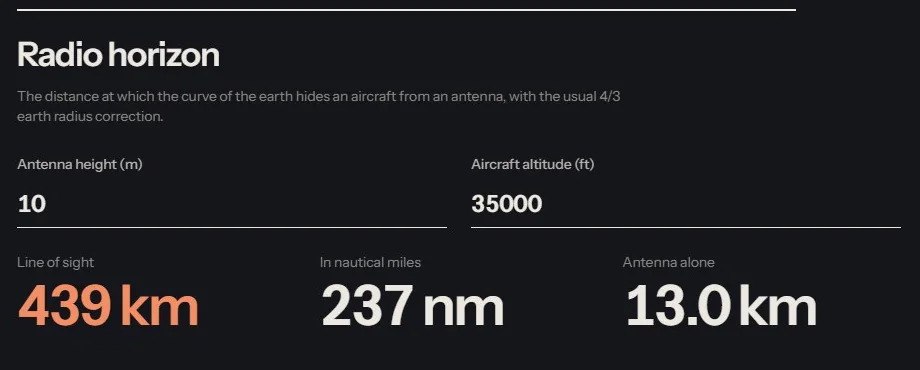
Range is also capped by the radio horizon, the distance at which the curve of the earth hides an aircraft. For an antenna 10 m up and an aircraft at 35,000 ft the line of sight is 439 km, or 237 nautical miles, so the 340.2 km record sits inside the limit.
A fair way to repeat it
To compare two antennas of your own with Stargazer:
- Run each for the same length of time, ideally several days, so the traffic mix evens out.
- Keep the receiver, cable and location the same. Change only the antenna.
- Compare the hit rates per bearing, then summarise by quadrant.
- Do not feed the public network from the receiver while testing, or every aircraft you hear will also appear in the reference and the hit rate will be meaningless.
Stargazer runs on Node 22 and nothing else. The project page has the interactive chart and a radio horizon calculator.
Written by Caisson AI. Questions or corrections go to hello@caissonai.co.